
Finding Chippewa County Recent Arrests
Chippewa County keeps no public booking roster online. The county jail publishes no 24-hour arrest list and no weekly Sheriff blotter. Its official correctional facility page says one thing clearly. Arrested people are lodged through the Booking Office. Names, photos, and timestamps are not part of that page. A private site using the county name is not an official arrest feed. Treat it with care.
Every Chippewa County arrest starts with an agency. Sault Ste. Marie Police, the Sheriff, Michigan State Police Post 82, or TRIDENT could hold the report. Then ask CCCF whether the person sits in county custody. MI-VINE tracks custody events, and MiCOURT picks up once a case is filed. A missing web entry does not mean no arrest happened.
| Time or custody window | Official public feed | Best documented route | Photo status |
|---|---|---|---|
| Same day | None verified | CCCF, arresting agency, MI-VINE, or FOIA | No official online policy found |
| Several days | No county blotter verified | Agency releases, court, local news, or FOIA | News images vary |
| Current custody | No roster verified | CCCF phone and MI-VINE | VINE is not a photo gallery |
| State supervision | MDOC OTIS | OTIS offender search | Profile image when available |
Chippewa County publishes no verified official feed for these windows. The 24 Hour Arrests route covers same-day confirmation. For multi-day and archival checks, the Arrest Log does the work.
Booking Begins at CCCF
CCCF's Booking Office is the county's intake gate. Officers there process everyone lodged at the jail. They also field questions about bail and arraignment dates. The facility accepts cash bonds only, or a bail bondsman can handle it. Checks and foreign currency are turned away. Those rules say nothing about bond eligibility or when an arrest reaches any outside database. The county's CCCF page shows the official facility and Booking Office context.
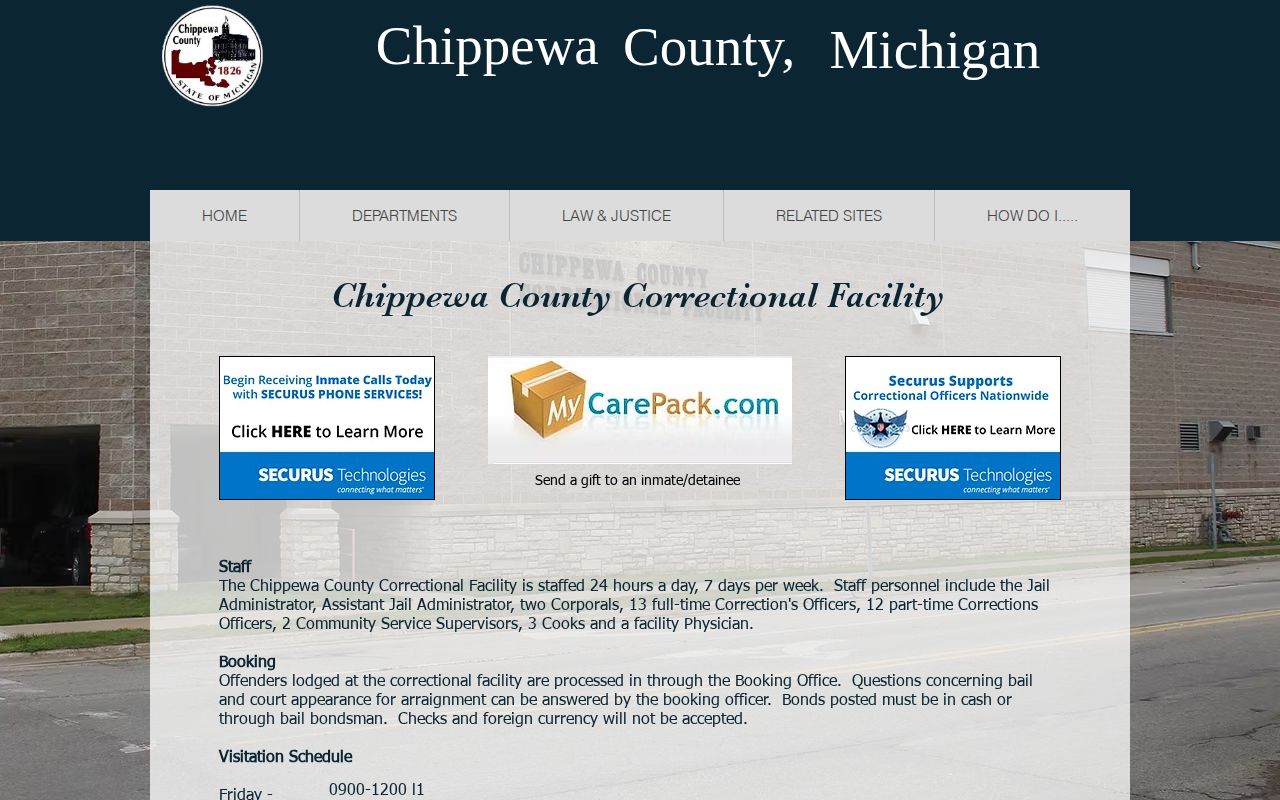
Note: The county page is facility information, not a searchable roster of people.
Chippewa County Arrest Roster Options
Chippewa County's official site posts no roster search form. There is no result table either. That means no public field list, no update stamp, no photo setting, and no archive to lean on. A real roster check has to work through the channels that do exist. Call Corrections at 906-635-7620. The Sheriff's Office line is 906-635-6355. Phone staff may hold back details, so a written request is the steadiest route to one specific arrest record. Gather the fields below for calls, MI-VINE searches, or written requests, since each system carries different data.
| Search detail | Why it helps | Where it may work |
|---|---|---|
| Full legal name | Starts the identity match | CCCF, VINE, court, OTIS |
| Date of birth | Separates similar names | Agency request or locator, subject to access rules |
| Booking or case number | Points to one record | CCCF, VINE, court |
| Arrest date and agency | Identifies the proper custodian | Police, Sheriff, FOIA |
| Custody status sought | Clarifies whether the question is current or historic | CCCF or VINE |
- Check the likely arresting agency and confirm whether it sent the person to CCCF.
- Call the Booking Office for a current county-custody question. Give a precise name and date if known.
- Use the VINELink Check for one person’s custody events and alerts.
- Request the booking record through county FOIA when the public web and phone route do not answer the records question.
Why Recent Arrests Go Missing
Several things can keep a fresh Chippewa County arrest off the web. Transport may still be underway. Intake may not be done. A person can also walk free before any outside publisher refreshes. The record may be restricted. Or the arresting agency may have issued no release at all. Third-party sites add confusion because each runs its own time window and archive depth. Their gaps and shifting counts say nothing about who CCCF actually holds, and with no county posting schedule, no exact lag can be promised.
Note: The court file for any Chippewa County booking carries the full account of the case.
Sheriff App Search Limits
The Chippewa County Sheriff app listing highlights tips, local resources, road and weather news, and offender searches. Its version history mentions an OTIS inmate search. OTIS belongs to the Michigan Department of Corrections. It tracks state prisoners and people under MDOC supervision. So it is not a live CCCF booking roster. The listing does not add a daily Chippewa County arrest-photo feed either. For release and transfer alerts, MI-VINE fits better, since Michigan runs it as a free, confidential service around the clock. A VINE result can still lag behind a fresh booking.
Where Chippewa Records Appear
Start any arrest search with official Chippewa County sources before anything else. Secondary publishers can hand you leads, yet each one may lag, duplicate entries, or go stale, and none of them is the actual Chippewa County jail roster.
| Channel | Official? | What it covers | Photo treatment |
|---|---|---|---|
| CCCF and Sheriff | Yes | County intake, custody, agency records | Request if held and releasable |
| MI-VINE | Yes | Custody and selected court-event status | No gallery |
| MiCOURT | Yes | Public court cases after filing | Not a mugshot source |
| MDOC OTIS | Yes | State custody or supervision | MDOC profile image when available |
| SooLeader and regional news | No, editorial | Selected agency releases and cases | May use agency or news images |
| RecentlyBooked, Mugshots.zone, Busted Newspaper, Mugshots.com | No | Publisher-controlled county indexes of varying age | Unofficial copies, verify at source |
SooLeader’s crime stream is the strongest local article feed located in the research.
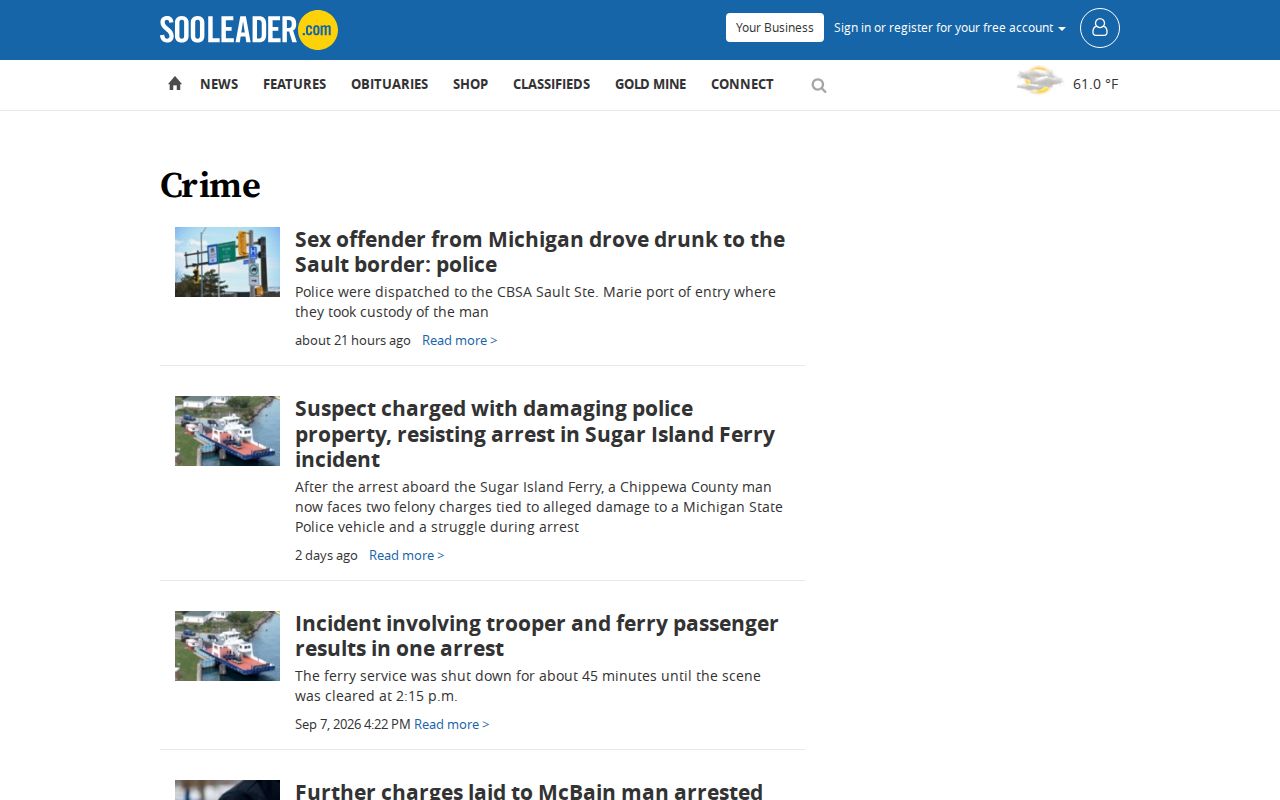
That county newsroom page runs crime stories, not a booking ledger or official arrest feed.
Recent Arrests by City
Each city page answers a different question. Sault Ste. Marie Recent Arrests walks through the full-service city police department, its records route, and how CCCF booking works. DeTour Village Recent Arrests takes the opposite path. No village police department is listed, so the page sends a record to the Sheriff or to whichever agency is named in it. The county holds just two incorporated places. Townships and smaller communities were left off the city list rather than relabeled. Record types matter too. A police report describes the arrest event, CCCF paperwork covers intake and custody, and the 91st District Court or 50th Circuit Court carries the case from there.
County Custody Paths
CCCF stays staffed every day. Programs for people in custody include GED coursework, counseling, Native American culture studies, work pass, tether, and community service. Those options cover detention and supervised release. None of them erases a booking record. Each case still runs its own court track. Don't confuse it with the state prisons nearby. MDOC runs Chippewa Correctional Facility at Kincheloe and Kinross Correctional Facility, and both hold state prisoners rather than county arrest bookings. County contract material also lists an ICE bed-day rate effective August 1, 2025. So county and immigration custody can overlap while the lookups stay separate: CCCF and VINE cover county events, and ICE keeps its own detainee locator.
Inside a Chippewa Arrest Record
A booking record covers intake and custody. A police arrest report is different. That report may hold a full event narrative, evidence, witnesses, and officer observations. The official CCCF site confirms a booking process. It promises no public online schema, so the field list below describes common record elements, not guaranteed web fields.
| Field | What it means |
|---|---|
| Name and facility identifier | Identifies the person and distinguishes the intake record |
| Arrest and booking time | Shows separate event and jail-acceptance points when recorded |
| Arresting agency | Identifies who holds the police report |
| Charges as booked | Lists charges at intake, not a judgment of guilt |
| Bond and court | Shows release conditions and the next procedural route when available |
| Custody or release status | Records jail movement, subject to timing and later holds |
| Booking photograph | An intake identification image, if created and releasable |
| Disposition | A later court outcome, not a booking field |
- Booking
- The jail intake process after a person is lodged.
- Arraignment
- The first court appearance where charges and rights are addressed.
- Bond
- A financial or conditional basis for release while a case is pending.
- Disposition
- The court result, such as dismissal, plea, acquittal, or conviction.
When Bookings Reach Court
The jail clock and the court clock run differently. The 91st District Court bond page explains the gap. Post bond, and a report date may come from an officer or jail staff. Someone held in custody goes to the next arraignment. Assaultive matters are usually arraigned the next business day unless a court orders otherwise. That is why a Chippewa County booking can exist before the public case display catches up.
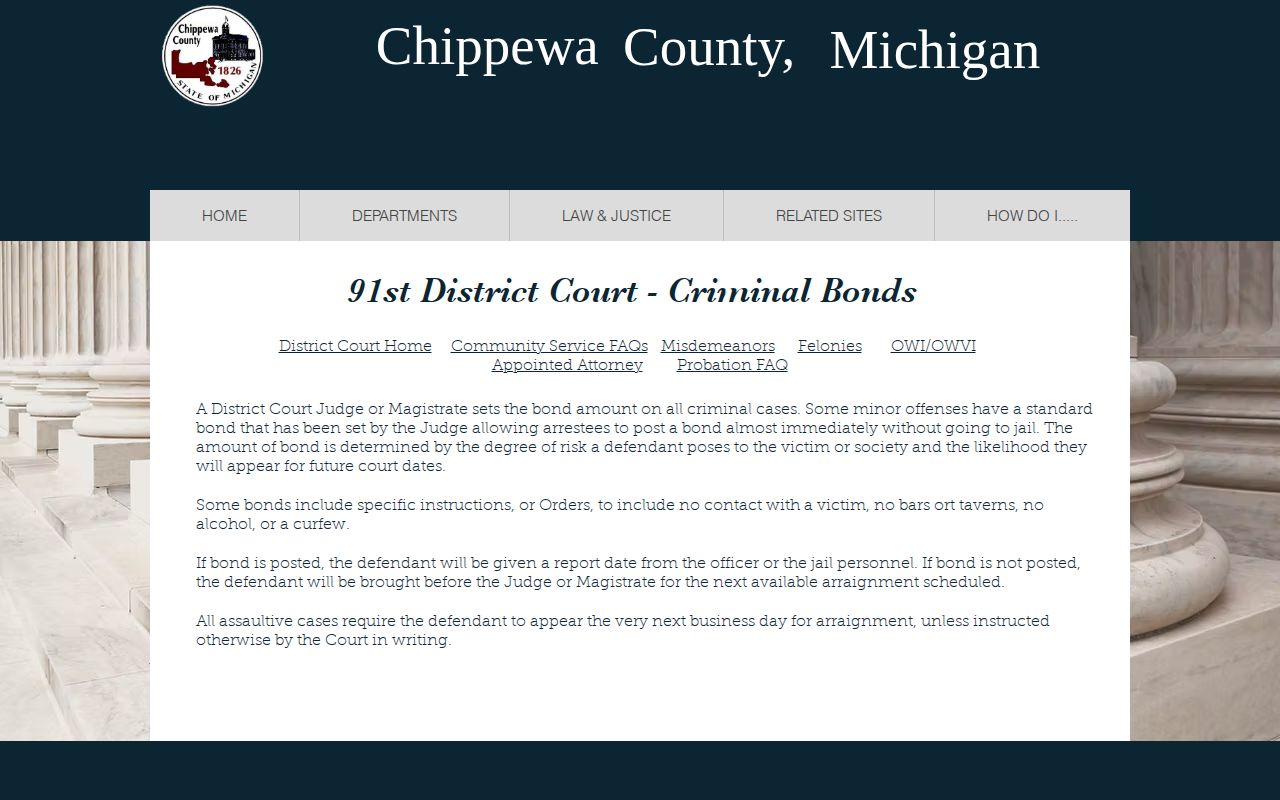
That court page covers procedure only, not a universal bond schedule or any list of arrested people.
Chippewa Court Case Stages
The 91st District Court handles misdemeanors and arraignments. It also manages the early felony stages. A preliminary examination asks one thing: does probable cause support sending a felony to 50th Circuit Court? If so, the case moves up. A circuit register of actions and final judgment can later supply the disposition. The intake record alone lacks it. The path runs: Arrest → Booking → Arraignment → Preliminary examination when required → Circuit proceedings when bound over → Disposition. Charges may change at any step. MiCOURT works well for public cases. It excludes juvenile and other nonpublic categories and warns that an online result is informational. A blank search can reflect scope, timing, or privacy rules. An absent result is not the absence of an event.
Chippewa Arrest Photos and Mugshots
The official CCCF pages say nothing about posting booking photographs online. Visibility windows and any digital-copy fee go unstated too. The accurate route is to request a specific image from the county or Sheriff custodian, subject to Michigan FOIA exemptions and redaction. A private aggregator photo proves nothing about CCCF policy. It may not even be current. Michigan has no general statute aimed at private mugshot publication or pay-to-remove activity. Still, FOIA, arrest-card rules, court set-aside law, and privacy or investigation exemptions shape official records. MDOC photographs are different again. One may appear on an OTIS profile for someone in state custody or supervision. That need not be the Chippewa booking photo. Can every arrest photo be obtained? No, a photo may not exist. The office asked may not hold it, or a lawful exemption may lead to withholding or redaction. Ask for the nonexempt portion and a written basis for any denial.
Requesting Chippewa County Arrest Records
Start at the Chippewa County FOIA page. It holds the request forms, policy, fee details, and the written request route. County and Sheriff requests go to the County Administrator's Office. The address is 319 Court Street, Sault Ste. Marie, MI 49783. Email works too: foia@chippewacountymi.gov. Describe the existing record. The county need not create a new summary or answer questions in place of producing records.
- Name the person, approximate arrest and booking dates, and arresting agency. Add a booking or case number if known.
- Ask separately for the booking record, arrest report, and booking photograph because different custodians or exemptions may apply.
- Request electronic delivery and the nonexempt portions if part of the record must be redacted.
- Expect a response within five business days, subject to one ten-business-day extension under the county summary.
- Review the estimate before paying. Standard paper copies are capped at $0.10 per page, and a deposit may be required when the estimate exceeds $50.
The captured county page shows the official request entry point.
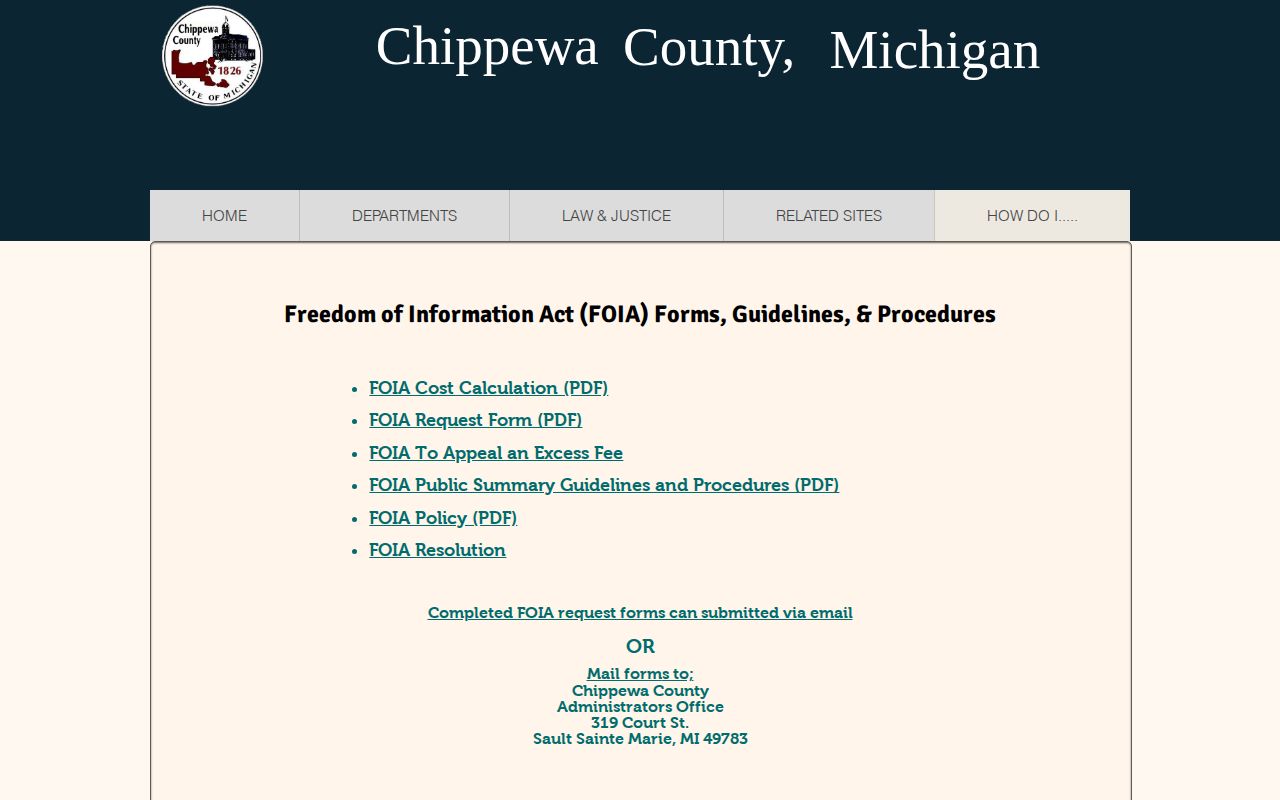
When no public roster or feed exposes a booking, the county FOIA process is the fallback.
What Chippewa Record Copies Cost
The county's public summary caps standard pages at $0.10. Estimates over $50 can trigger a deposit. Sault Ste. Marie's schedule lists police report copies at $0.10 per page and $0.50 for color. Neither document sets a CCCF booking-photo fee. Ask for a written estimate rather than assuming the police report price controls a jail image.
Michigan Arrest Record Law
MCL 15.243 allows privacy and law-enforcement exemptions. That includes material whose release could interfere with proceedings or cause an unwarranted invasion of privacy. Not everything is public. Juvenile identifiers, protected victim information, medical data, sealed material, and active investigative details should not be assumed public. Agencies should separate releasable portions where practical.
Michigan General Schedule 11 splits retention from web display. Booking and control-center logs stay through the end of the calendar year plus seven years. Inmate jackets last until release plus ten years. A jacket can include intake records, booking cards, mug shots, release papers, bonds, and warrants, and a page vanishing does not prove the file was destroyed.
Correcting a Booking Photo
Fix the record at its source before anything else. A dismissed charge, a sealed case, a set-aside order, or a mistaken identity all need paperwork. That paperwork comes from the court and the agency that made the arrest. Michigan's Clean Slate materials lay out automatic and application-based relief, along with the exceptions. One court order, though, rarely reaches every copy of a booking photo floating around online.
Then work each publisher's free correction route. Busted Newspaper asks for the listing URL plus proof of the qualifying outcome. RecentlyBooked accepts free requests covering dismissed, sealed, incorrect, outdated, wrong-person, juvenile, and duplicate entries. Mugshots.zone posts a county removal form. Mugshots.com lists no clear county-level free path. Arrests.org carries no reliable Chippewa coverage.
Skip any service that promises universal removal for a fee. The same goes for sending ID documents to an unverified business. Once a source page comes down or changes, Google's outdated-content refresh can update the search result. It fixes indexing only. The source itself stays untouched.
Chippewa Arrest Warrants and Wanted Lists
Chippewa County keeps its warrant information close. The sheriff's office names a Warrant Officer in its directory. Beyond that, the county publishes no active-warrant search and no official most-wanted list for Chippewa County. No update schedule or photo policy exists for public review either. MiCOURT can surface a related court case by name, but it cannot confirm whether an arrest warrant is active, recalled, stayed, or executable. For a real answer on warrant status, call the 91st District Court at 906-635-6320 or the Sheriff at 906-635-6355.
Worried about your own record? Speak with the court or a lawyer. Never confront or try to detain someone who appears on a listing. The official Sheriff page explains the agency's route for warrant questions without hosting a wanted gallery. A separate TRIDENT tip line, 906-630-0249, handles drug-task-force tips, though it does not confirm arrest warrants.
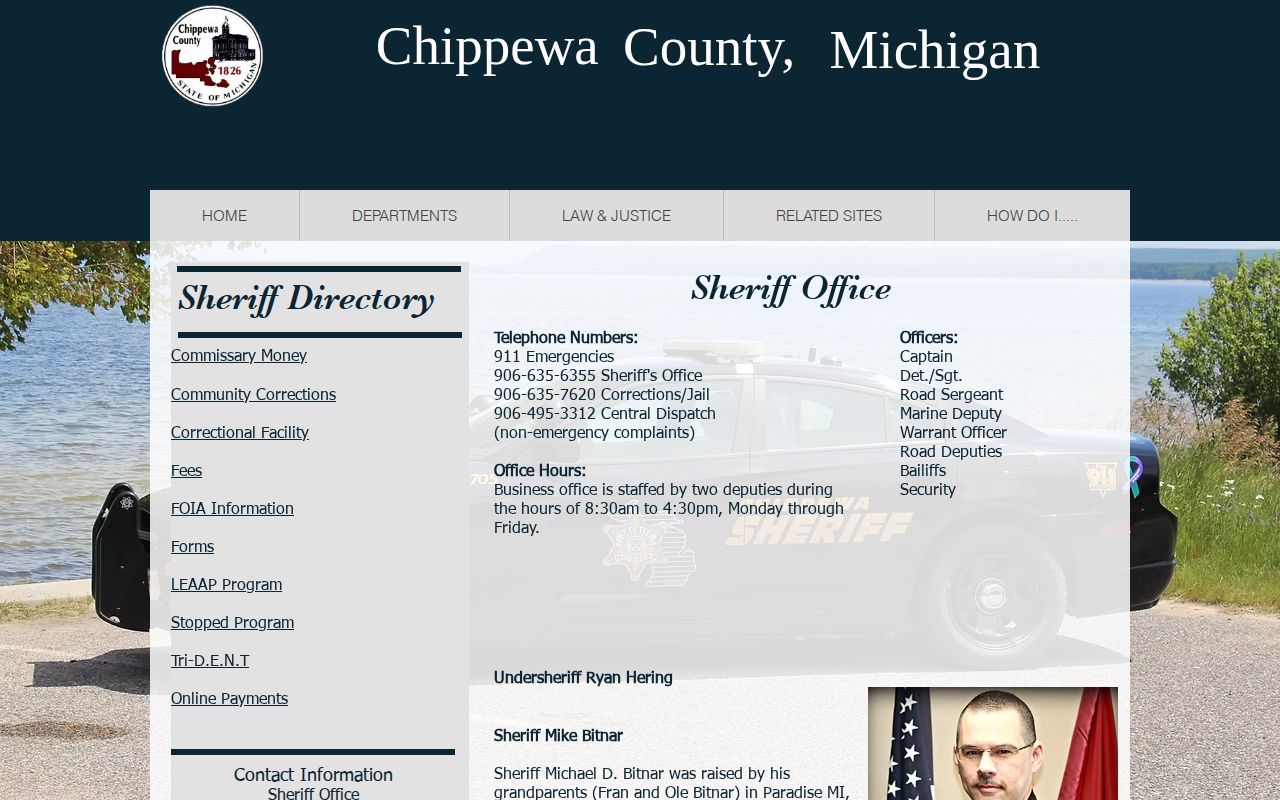
The capture supports direct agency contact rather than reliance on unofficial wanted labels.
TRIDENT Record Routing
TRIDENT covers Chippewa, Mackinac, and Luce counties in a border-region drug-enforcement role. A TRIDENT arrest may make local news. It may land someone at CCCF. The investigative record, jail intake, and court file still sit with separate custodians, so one request rarely covers them all. Check any agency named in a news report. Match it against the police report and court file. News coverage, driven by events, is never a full Chippewa County arrest log.
Custody Beyond County Arrests
Custody questions reach past county arrest records. The MDOC OTIS search lists state prisoners, parolees, and probationers. It also covers people discharged from supervision within its stated window. It leaves out people merely arrested, unsentenced county-jail detainees, and jail-only sentences. Search by offender number when you can. Otherwise try a last name. Then narrow with first name, age, race, sex, status, or identifying marks.
The BOP inmate locator tracks federal prisoners but offers no public booking-photo gallery. ICE's ODLS covers immigration detention through A-number or biographical searches. MI-VINE is not a complete federal locator. Keep these systems straight, since custody can transfer after a Chippewa County arrest.
Chippewa County Sheriff’s Department Location and Directions
Public Record Search
Sponsored Results